Introduction
A Three-Way Stopcock in India may be used in hospitals, clinics, intensive care units, emergency departments, and other healthcare settings where controlled fluid management is required. It may also be connected with compatible extension tubes when additional length or convenient positioning is needed within a medical fluid-line configuration.
Understanding the Three-Way Stopcock Structure
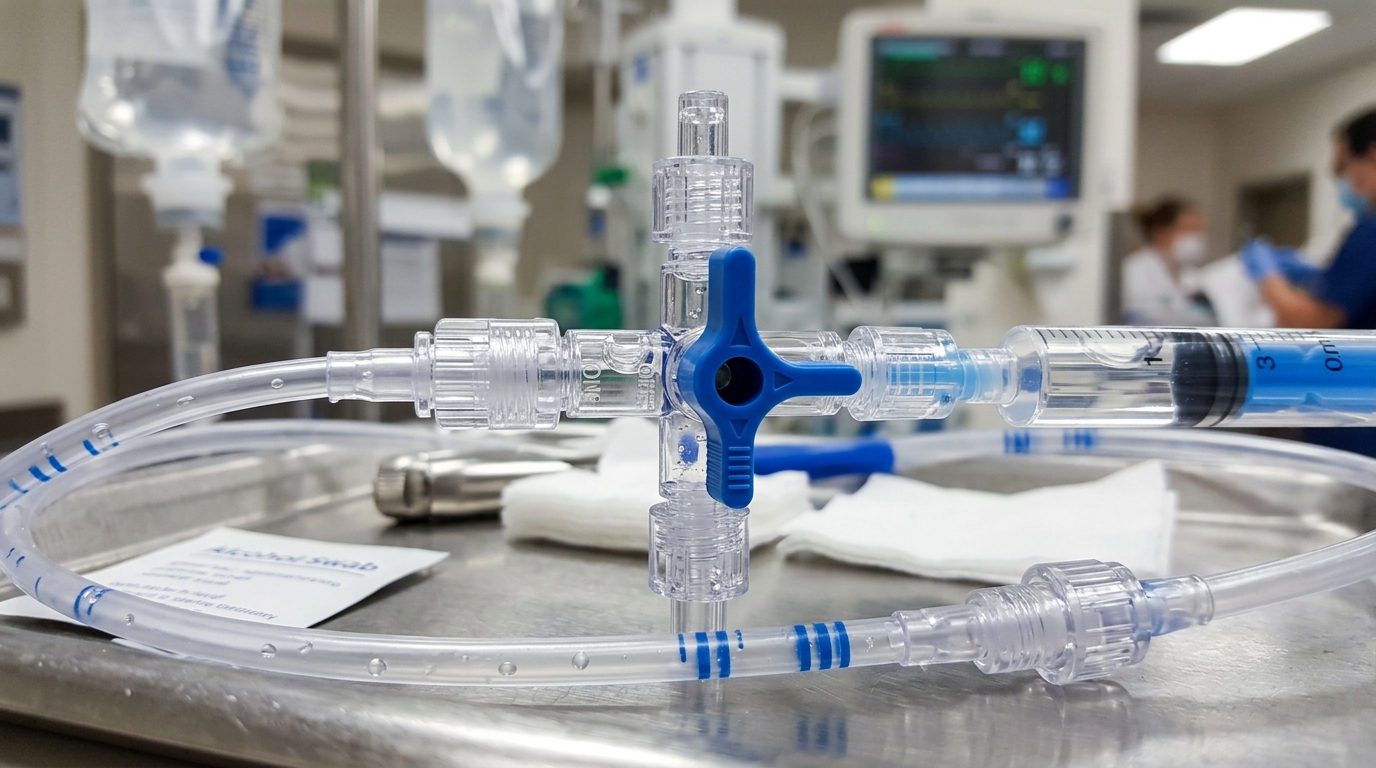
A three-way stopcock consists of three connected ports and a rotating handle. The handle can be positioned to regulate which pathways remain open and which are closed, allowing healthcare professionals to manage fluid movement between connected lines without repositioning the entire tubing system.
This configuration allows the device to be incorporated into suitable IV and medical tubing systems according to the demands of a particular procedure.
Common Healthcare Applications
Three-way stopcocks can be used in various clinical scenarios where controlled access to fluid lines is required. They are commonly associated with IV therapy and fluid management systems.
Depending on the clinical application, they may also be used to provide access to a connected line for medication administration or other procedures. Their use can be found in intensive care, emergency care, operating rooms, and general hospital treatment settings across India.
The device should always be selected and used according to the specific procedure and suitable clinical methods.
Controlling Fluid Pathways
The rotating handle determines the available flow path. By changing the handle position, a healthcare professional can open or close specific ports and direct fluid through the required connection.
Before use, all connections should be inspected carefully to ensure they are secure. The handle must then be positioned according to the required flow direction, with the system monitored during use.
Practical Benefits of Three-Way Stopcocks
The three-port arrangement allows healthcare professionals to manage fluid movement between chosen pathways with a simple handle rotation.
A stopcock can provide controlled access to a connected line without requiring the complete tubing setup to be changed or rearranged.
Using an appropriate stopcock can help organize multiple connections and make fluid-line administration more convenient across India's healthcare facilities.
Controlled access to connected lines can help minimize repeated handling or interference of the main tubing system when the procedure permits it.
Safety and Infection Control
Since stopcocks can be connected to systems involved in patient care, appropriate handling and infection-control practices are essential. Healthcare professionals should follow their facility's recommended hand hygiene and aseptic handling procedures.
Before use, the device should be examined for cracks, leakage, blockage, damaged packaging, loose connections, or other visible defects. Any product that appears compromised should not be used.
A Three-Way Stopcock in India must be used according to the manufacturer's directions, product specifications, and the requirements of the intended clinical procedure.
Factors to Evaluate Before Choosing a Stopcock
The appropriate stopcock should be chosen according to the devices and procedure for which it will be used. Several factors may need to be considered before selection:
- Connector Compatibility — Ports should be compatible with the clinical tubing and devices being connected, especially when paired with extension tubes
- Material and Construction — Suitable for the intended medical application and handling requirements
- Pressure Requirements — Compatible with the pressure conditions of the intended application
- Handle Operation — The rotating handle should provide clear and practical control of the required flow pathways
- Intended Application — The chosen device must match the specific clinical procedure and equipment requirements
Guidelines for Safe and Effective Use
Before use, healthcare professionals should evaluate the packaging and device condition. The stopcock should be checked for visible issues and verified to be appropriate for the intended application.
After connecting the device, all connections should be secured appropriately. The handle should be positioned carefully according to the required flow pathway, and the system should be monitored throughout the procedure.
Following manufacturer instructions, facility protocols, and suitable infection-control practices can support secure and efficient usage.
Conclusion
Three-way stopcocks provide a convenient means to manage fluid movement between connected medical lines. Their three-port design and rotating handle allow healthcare professionals to handle chosen flow pathways according to the demands of a procedure.
Mediplus India Ltd supplies medical device solutions for healthcare applications, including products designed to support fluid-management needs in appropriate clinical environments.
Frequently Asked Questions (FAQs)
1. What is a three-way stopcock used for?
It is used to regulate fluid movement between three connected pathways in suitable medical tubing systems.
2. How does a three-way stopcock work?
Its rotating handle changes the connection between the three ports, allowing specific pathways to be opened or closed as required.
3. Where are three-way stopcocks commonly used?
They may be used in IV therapy, intensive care, emergency departments, operating rooms, and other healthcare applications involving controlled fluid management.
4. What should be checked before using one?
The device, packaging, connectors, and compatibility with the connected equipment should be evaluated before use.